
Categories

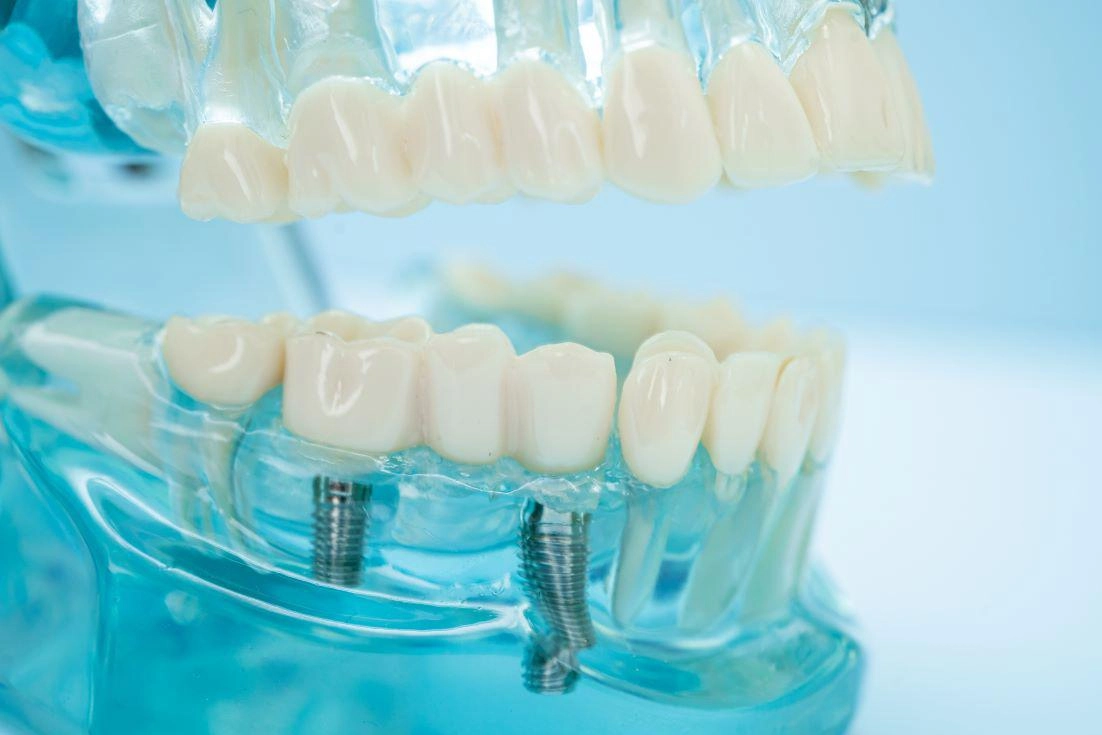

Many patients come to us with a confusing pattern: no new cavities, no obvious gum disease, and yet a long history of dental work that keeps needing to be replaced. Crowns that fracture, fillings that fail, teeth that wear down. Repeated repairs over time that never seem to fully “solve” the problem.
Often, the missing piece is not decay or disease, but excess force in the system.
Understanding “too much force”
When there is more pressure placed on the teeth than they are designed to handle over time, the result can show up in many different ways, including:
- Tooth wear or flattening
- Cracks or fractures in teeth and restorations
- Gum recession
- Tooth sensitivity
- Increased risk of periodontal breakdown
- Changes in bone structure over time
- Headaches/migraines, jaw tension, or facial pain
Although these symptoms look different, they often share a common underlying driver: bruxism, the clinical term for clenching and grinding.
Clenching vs. Grinding
Bruxism is typically described as either grinding or clenching. While they are related, they are not exactly the same.
Grinding is the movement most people recognize: the jaw shifts side to side, often during sleep, creating wear patterns or fracture lines on teeth and restorations. It’s often audible to others and associated with visible surface damage.
Clenching, on the other hand, is often less visible but just as impactful. When someone clenches, the jaw muscles remain tightly contracted without the same lateral movement. Because of this, patients may not show obvious wear on their teeth, but can still experience gum recession, excess bone development, jaw fatigue/tightness, headaches/migraines, and tooth sensitivity without clear structural damage.
In many cases, clenching is present even when teeth appear relatively intact.
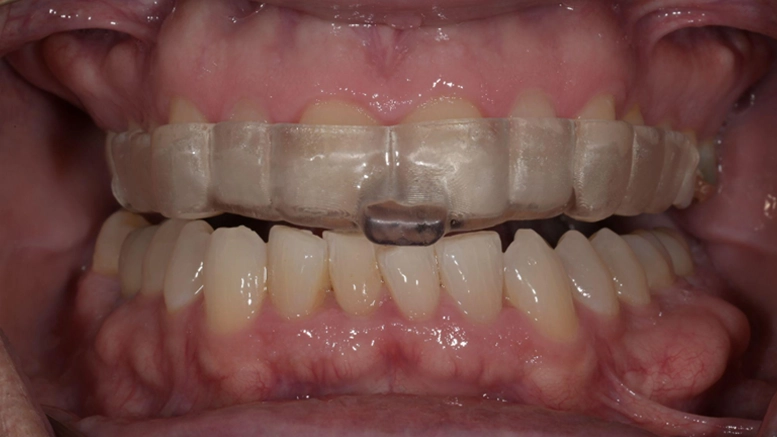
Why a night guard is not always the solution
A common first step in managing bruxism is the use of a splint (often called a night guard). These devices create a protective barrier between the teeth to reduce damage during clenching or grinding. In many cases, this can be a helpful part of care. However, a splint primarily addresses protection, not necessarily muscle activity.
Over time, some patients find night guards uncomfortable or difficult to maintain consistently, which can reduce long-term effectiveness.
Our approach to managing bruxism
Our focus is not only on protecting the teeth, but on understanding and reducing the forces driving the damage in the first place.
We use splint therapy as part of a broader strategy that is designed to:
- Reduce excessive muscle activity when possible
- Protect teeth and restorations during periods of high force
- Improve long-term stability of dental work
- Adapt over time as patterns change and improve
For some patients, this approach can significantly reduce symptoms and the need for ongoing protective appliances. For others, long-term splint use remains an important part of maintaining stability. Every case is different, and treatment is adjusted based on how your system responds over time.
A more sustainable way forward
When dental work keeps failing, it is easy to assume the problem is the materials, the restorations, or even the teeth themselves. But often, the deeper pattern is simply that the system is under more pressure than it can comfortably hold. Once that is identified, the goal becomes not just repair, but creating balance, stability, and longevity for the work we do together.